SKU: 23619788079
wildflower seed bags

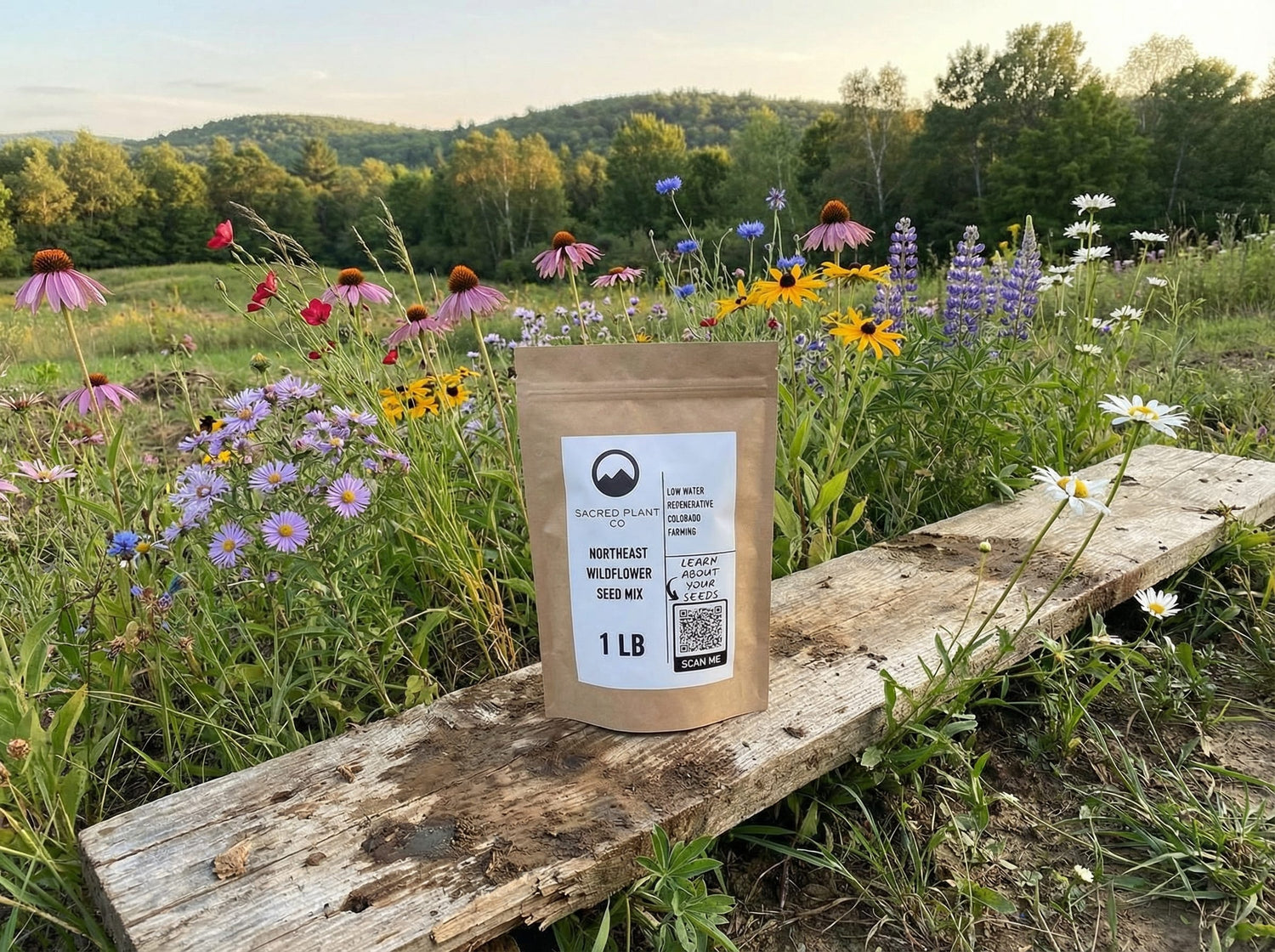
wildflower seed bags Northeast Wildflower Seed Mix for USDA Zones 3 to 8 4 oz

Sale price$22.96 Regular price$25.51
Save 10%

Shipping Estimate
USA
  • USA
  • CAN

Ships within 48 hours · Estimated delivery Jul 9 - Jul 14

Promo Codes Available:

For Your Every Summer RSVP, with Code: SUMMER15

Description

wildflower seed bags Northeast Wildflower Seed Mix for USDA Zones 3 to 8 4 ozNortheast Wildflower Seed Mix for USDA Zones 3 to 8 Bring a season long sweep of color to a cold climate landscape. We built this cold hardy wildflower seed mix for the Northeast, including Connecticut, New York, Pennsylvania, and the surrounding region, across USDA Zones 3 to 8. It is made for cool springs, humid summers, and the swing of a Northeastern autumn, blending fast annuals with biennials and perennials so the planting looks striking from

🌼 Northeast Wildflower Seed Mix for USDA Zones 3 to 8

Bring a season-long sweep of color to a cold-climate landscape. We built this cold-hardy wildflower seed mix for the Northeast, including Connecticut, New York, Pennsylvania, and the surrounding region, across USDA Zones 3 to 8. It is made for cool springs, humid summers, and the swing of a Northeastern autumn, blending fast annuals with biennials and perennials so the planting looks striking from year one and gets better every season. These are quality, US-grown seeds, non-GMO, chemical-free, and never artificially coated.

🌸 Expect a layered display that runs 36 to 48 inches tall: scarlet flax and corn poppy against tall blue cornflower, perennial lupine, rocket larkspur, gayfeather, and New England aster, with golden coreopsis and black-eyed Susan, warm Siberian wallflower, and crisp white baby's breath, Shasta daisy, and sweet alyssum threaded throughout. With roughly 30 percent annuals for first-season color and 70 percent biennials and perennials for staying power, the color keeps coming as the stand fills in. New to sowing a meadow? Our How to Grow Wildflowers from Seed guide walks you through it step by step.

🌻 Meadows & garden beds
Scatter for a natural, layered meadow or a diverse, long-blooming border.
🐝 Pollinator habitat
A continuous, nectar-rich bloom cycle that supports bees, butterflies, and beneficial insects.
🌾 Restoration plantings
Diverse, hardy species that work well for meadows and roadside restoration.
❄️ Fall dormant seeding
Sow before frost and let winter cold-stratify the seed for a strong spring.

Planting in a different climate? Reach for our Southwest Wildflower Mix for hot, dry, low-elevation gardens, or our Mountain Wildflower Mix for high-elevation Western landscapes.

🌱 From the Sacred Plant Co Farm. Sacred Plant Co is a soil-first farm. Our own farm in Colorado earned a groundbreaking Haney Soil Health Score of 25.4, a number that surpasses the soil biology measured in pristine forest land. That score is the heart of who we are. We believe healthier soil grows more complex, more resilient plants, and that philosophy is the standard behind everything we grow and everything we carry.

Product Specifications

Detail Specification
Common Name Northeast Wildflower Mix
Botanical Composition Multi-species blend (19 wildflower species)
Format Wildflower seed mix (annuals, biennials, and perennials)
Available Weights 1/2 oz, 1 oz, 2 oz, 4 oz, 1/2 lb, 1 lb
Mature Height 36 to 48 inches
Recommended Region USDA Zones 3 to 8 across the Northeast (CT, NY, PA and beyond)
Bloom Composition About 30% annuals, 70% biennials and perennials
Grade Non-GMO, untreated (chemical-free, uncoated)
Seed Purity 95 to 99 percent
Germination / Viability 70 to 95 percent
Testing Status Seed purity and germination tested, per lot
Country of Origin USA

Full Seed Mix Composition

  • 17% Baby's Breath, Annual (Gypsophila elegans)
  • 13% Wallflower, Siberian (Erysimum allionii)
  • 12% Scarlet Flax (Linum grandiflorum)
  • 11% Lance-Leaved Coreopsis (Coreopsis lanceolata)
  • 7% Cornflower, Tall Blue (Centaurea cyanus)
  • 7% Purple Coneflower (Echinacea purpurea)
  • 7% Lupine, Perennial (Lupinus perennis)
  • 4% Shasta Daisy (Leucanthemum superbum)
  • 4% Corn Poppy, Mixed (Papaver rhoeas)
  • 3% Sweet William Pinks (Dianthus barbatus)
  • 3% Rocket Larkspur (Delphinium ajacis)
  • 3% Indian Blanket (Gaillardia pulchella)
  • 2% Snapdragon (Antirrhinum majus)
  • 2% Gayfeather (Liatris spicata)
  • 2% Catchfly (Silene armeria)
  • 1% Hairy Beardtongue (Penstemon hirsutus)
  • 1% Black-eyed Susan (Rudbeckia hirta)
  • 0.5% New England Aster (Symphyotrichum novae-angliae)
  • 0.5% Sweet Alyssum, Tall White (Lobularia maritima)

🌱 How to Plant

Prepare your site by clearing debris and loosening the soil so seed makes good contact with bare ground. Broadcast the seed evenly, rake lightly, and press it into the soil. Bury seed no more than 1/4 inch deep, then keep the soil moist until germination.

Seeding rate

1/4 lb covers 625 to 1,250 sq ft, or 1 lb covers 2,500 to 5,000 sq ft. For a natural, meadow-like look, use the lower end. For balanced color and pollinator activity, use the middle of the range. For a full, lush display, choose the upper end.

Best time to plant: early spring as the ground thaws, or as a late-fall sowing before the first frost, which gives the seed natural cold stratification over winter for stronger spring germination.

Safety & Responsible Use

This is a horticultural seed mix for planting and ornamental use, not for human or animal consumption. A few species in the blend, including Perennial Lupine and Rocket Larkspur, can be harmful if eaten, so we suggest keeping the seeds and growing plants out of reach of children, pets, and grazing animals. Wash your hands after sowing, and store unused seed in a cool, dry place away from food.

These statements have not been evaluated by the Food and Drug Administration. This product is not intended to diagnose, treat, cure, or prevent any disease. For guidance specific to your situation, consult a qualified professional.

🌼 Our 100% Money-Back Guarantee

Our policy is simple: if you aren't happy, send it back and receive a full refund. Anytime, for any reason.

Frequently Asked Questions

Which regions and USDA zones is this seed mix made for?

We built this cold-hardy blend for the Northeast, including Connecticut, New York, Pennsylvania, and the surrounding region, across USDA Zones 3 to 8. It is at home in cool springs, humid summers, and the swing of a Northeastern autumn, so the annuals, biennials, and perennials in the mix establish well and come back stronger each year. It also performs nicely across much of the upper Midwest.

Will these wildflowers bloom the first year?

Yes. About 30 percent of the mix is fast annuals that bring color in the very first season, while the remaining 70 percent is biennials and perennials that return and expand in the years that follow. You get a striking display from year one, and the stand deepens and fills in over time.

When should I plant in the Northeast, and how much seed do I need?

Plant in early spring as the ground thaws, or in late fall before the first frost. A fall sowing gives the seed natural cold stratification over winter, which sets up strong spring germination. For coverage, 1/4 lb covers 625 to 1,250 square feet and 1 lb covers 2,500 to 5,000 square feet. Use the lower end of the rate for a natural, meadow-like look, the middle for balanced color and pollinator activity, and the upper end for a full, lush floral display.

Are these seeds treated or GMO, and what if I am not happy with them?

Every batch is non-GMO, chemical-free, and never artificially coated, just clean seed selected for purity of 95 to 99 percent and tested for germination at 70 to 95 percent, so you know exactly what is going in the ground. That same transparency runs through our 100% money-back guarantee. Our policy is simple: if you aren't happy, send it back and receive a full refund. Anytime, for any reason.

Shipping Notes
  • Free Standard Shipping on $100+ Orders to the USA.
  • Except Preorder products are shipped in 48 hours.
  • Delivery to the USA:
  1. Standard Shipping : 3-10 business days
  • If time is of the essence, please consider selecting expedited delivery for faster service.
Exchange/Return Notes
  • We offer a 30-day return/exchange service after receiving.
  • Final sale items are not eligible for returns or exchanges.
  • To process your return/exchange, please contact us at [email protected]
  • Please click here for more details>>> Return & Exchange Policy
SKU: 23619788079

Discover Niche Categories That Outsell wildflower seed bags

Top-Converting Item to Boost Your Average Order

4.3 ★★★★★
Based on 1029 reviews
Sort
Highest Rating
Newest First
Oldest First
Product Reviews
L
Verified Purchase
Luigina B Yerino
Los Angeles, US
★★★★★ 5
Native American telling of the Nativity
Format: Hardcover
Intriguing. Told through Native American thought. I've shared it with others who in turn have purchased it for their grandchildren. Led me to purchase the New Testament translated by the same person.
WAS THIS REVIEW HELPFUL?YesReportShare
Reviewed in the United States on April 16, 2025
R
Verified Purchase
Ryan Remington
Los Angeles, US
★★★★★ 5
Wow.
Format: Hardcover
Not only did Terry Wildman knock the retelling out of the park, the artists created a visually stunning representation of the story. I am in awe and can’t wait to find worthy applications of this book.
WAS THIS REVIEW HELPFUL?YesReportShare
Reviewed in the United States on September 28, 2024
J
Verified Purchase
Jon and Carissa Yoder
Omaha, US
★★★★★ 5
Beautiful
Format: Hardcover
The familiar story of Jesus through the lens of a First Nations storyteller. It is beautiful and brought me to tears. I can’t wait to read it to my kids.
WAS THIS REVIEW HELPFUL?YesReportShare
Reviewed in the United States on November 30, 2024
S
Steph A
West Palm Beach, US
★★★★★ 5
Insightful Iteration of the Christmas Story, Minus the European Lens
Format: Hardcover, Format: Hardcover
Premise Birth of the Chosen One is a picture book adaptation of the birth of Jesus, with text taken from the First Nations Version: An Indigenous Translation of the New Testament. This translation was overseen by Terry M. Wildman, in collaboration with an intertribal committee of First Nations Americans. I recommend checking out the website to learn more about this beautiful project, and checking out the clip of the First Nations version of The Lord’s Prayer. A quick disclaimer: Although I am multitribal Indigenous American, I am not well-acquainted with the culture. As I struggled a bit to write this review, I shared the story with my mom, who is much more familiar with our culture. To my observation, my mom found the book to be beautiful and moving. Storytelling The story of Jesus’ birth, attested to in Scripture, is often filtered through a European lens. So often, nativity portrayals depict lightly complected versions of Mary and Joseph– an incongruous incarnation of their middle-Eastern heritage. Renaissance artwork was, I believe, instrumental in forming these pictures within the western imagination. Birth of the Chosen One tells the story of Jesus’ birth through the lens of Indigenous American storytelling. I’m so grateful for this portrayal, which offers representation to young Indigenous readers, while also affording those of other backgrounds insight into a different culture. Translation of Proper Nouns One of the most striking elements that distinguishes this translation of the Christmas story from more common English translations is the translations of the names. While reading the story to myself, I was a bit perplexed by some of the names (Mary, for example, is known as Bitter Tears). In sharing the story with my mom, however, she pointed me to the Hebrew origins of the familiar names we read in the Christmas story. I learned from my mom that one meaning of Mary is, indeed, “bitter,” and we also learned from the story that Bethlehem means “House of Bread.” As my mom pointed out, this is a very powerful truth, since Jesus describes Himself as the “Bread of Life.” Throughout the story, these translated names bring new meaning to the birth of Jesus. It was eye-opening to see how much of the story is missed, with Anglicized names that don’t mean as much to the average reader as they would have meant to the Ancient Hebrew/Jew. Helpfully, the Author’s Note at the end of the story offers a list of corresponding Anglicized / translated names and locations. Narrative Rendering Just as the translated nouns bring fresh meaning to the familiar account of Christmas, the narrative also draws out the truth of Jesus’ coming in a way that is both powerful and meaning-ful. Jesus Himself spoke in stories, and I am personally a huge fan of allegory. For me, the different style presented the sweet simplicity of the truth of the Gospel, with refreshing novelty. The words of Jesus’ birth, so familiar to me, take on new meaning with different stylistic presentation. My favorite passage in the story comes from the mouth of Creator’s Chosen One (the angel Gabriel). He tells Bitter Tears, “He will set people free from their bad hearts and broken ways.” I consider the phrase “bad hearts and broken ways” to be a more meaning-ful iteration of the concept of sin. And, the Gospel itself is referred to as “the good story,” which I considered to be a beautiful (and once again, more powerful) descriptor. Illustrations Hannah and Holly Buchanan render the story of Jesus’ birth in lively colors, with images that bring First Nations culture to life. The twin sisters are completing PhDs in art history, and the Indigenous characters are depicted in traditional attire. While I don’t have the vocabulary to describe all of the details, I do really like seeing the Nativity presented in this way– with characters portrayed in a more relatable way. Readers who are not First Nations have the opportunity to visit Bethlehem, the House of Bread, in a new way, rather than in the style and coloration of European art. The following elements stood out to me: Use of sweet, colorful wildflowers– both in the meadow landscape and as a decorative vine/garland Jesus’ star is portrayed as hugely illuminating and BRILLIANT, with the size and radiance of a sun The characters’ faces are expressive. Bitter Tears often appears solemn or thoughtful. The Seekers of Wisdom blend thoughtfulness and hope. Chief Looks Brave (Herod) appears as a stony-faced background silhouette. (I found this stylistic choice to be especially effective). Content / Discussion Note On the page about the heavenly chorus, the text describes “a great number of spirit warriors.” The illustration includes the single “spirit-warrior,” portrayed as a man with eagle feathers and an eagle headress– alongside other eagles. My hesitation here is that the spirit-warriors / angels are being depicted as eagles. The book of Ezekiel, however, does describe certain supernatural beings with aquiline characteristics. Recommendation Status Birth of the Chosen One is an important Christmas story because it removes the Western lens through which many of us have been taught to read the nativity. The direct translations from the original Hebrew language are eye-opening and offer much-needed context. I would consider myself well-acquainted with the Christmas story, and I learned from this book. I’m also so happy for the representation offered in Birth of the Chosen One. Recommended for readers of all ages, regardless of cultural background. Disclosure: I received a complimentary copy of the book from the publisher. Opinions expressed are my own.
WAS THIS REVIEW HELPFUL?YesReportShare
Reviewed in the United States on November 30, 2024
M
Mouttet Menagerie
Whiting, US
★★★★★ 5
Native retelling of Christmas story
Format: Hardcover
Birth of the Chosen One is a beautiful retelling of the Christmas story. I will say that I struggled with the reading of it from the aspect of years (and years) of hearing and reading the original version. I can see where Birth of the Chosen One could be a good introduction to Christianity for First Nation Peoples or Native Americans. I appreciated that Terry Wildman has both Ojibwe and Yaqui heritage. I also appreciated that the illustrators are members of the Miami tribe. Experience as a tribal member gives these three the authority to present a Native American version of the story. The book closes with a note from Terry Wildman that will help readers keep track of the Native American names in the story. I received a complimentary copy of Birth of the Chosen One. This is my honest review.
WAS THIS REVIEW HELPFUL?YesReportShare
Reviewed in the United States on October 28, 2024

recommand products